

Design
7 min read
WordPress Website Examples for Small Businesses
Real WordPress sites we built for small businesses, from an electrician to a watch dealer, with what each one had to do…
Helen Marsh · 25 Aug 2026
Design

A good website brings in enquiries, not just compliments. Here is what actually makes a website good, in plain English, and how to tell if yours measures up.
Most people know a good website when they see one, but it is harder to say why. After years of designing websites for small businesses across Kent, we have learned that a good website is not about looking flashy. It is about doing a job: turning the people who visit into people who get in touch. Here is what actually makes a website good, in plain English, and how to tell if yours measures up.
A good website loads fast, works on a phone, and makes it obvious what you do and who you help. It guides visitors to take the next step, earns their trust, and is easy to find on Google. Looks matter, but only once those basics are right. A pretty site that no one can find, or that no one can use on a phone, is not a good website.
People leave slow websites, and they do it quickly. A 2017 Google/SOASTA study found the chance of a mobile visitor leaving rises by around 32% as a page goes from 1 to 3 seconds to load, and by around 90% from 1 to 5 seconds. In our experience the usual culprits are huge unoptimised images, too many plugins, and cheap shared hosting. A good website loads quickly on a normal phone and a normal broadband connection, not just on a fast office computer. Speed is also part of how Google ranks pages, through its Core Web Vitals, so getting it right helps you twice: visitors stay, and you rank better.
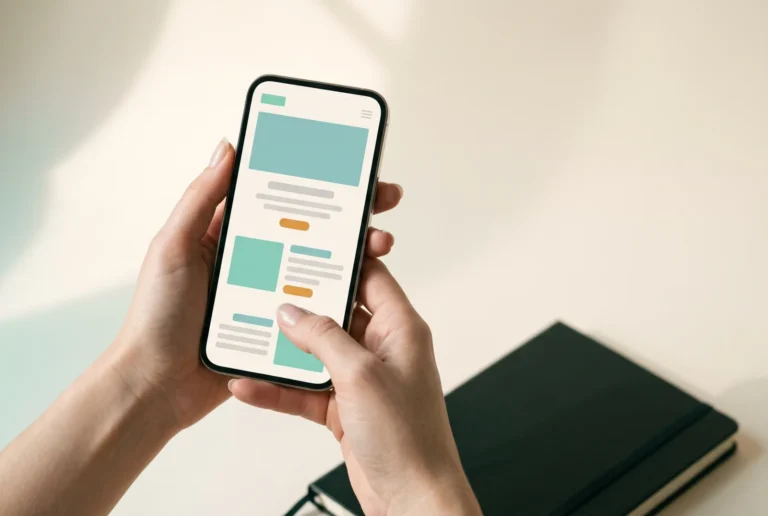
Yes, because that is where most of your customers are. Around 60% of UK web traffic is now on mobile (StatCounter, 2025), and for many local businesses it is even higher. A good website is designed for a small screen first: text you can read without pinching, buttons big enough to tap with a thumb, and forms that are quick to fill in one-handed. We design and test on real phone screens, not just by shrinking the desktop view, because that is where your enquiries come from. A site that looks fine on a laptop but is fiddly on a phone is quietly turning customers away, so it is worth knowing how to make a website mobile friendly.
Within about five seconds, a visitor should know three things: what you do, who you do it for, and where you are based. That belongs at the very top of the page, in plain words, before anyone has to scroll. For a local business it pays to say your area out loud. A builder in Maidstone should say “builder in Maidstone”, not “construction solutions”. Being clear about your location also helps the right customers, the ones near you, choose you over someone two counties away.
Good copy speaks to the customer, not about the business. The most common mistake we see is a homepage full of “we were founded in” and “our mission is”, when the visitor only wants to know whether you can help with their problem. A good website answers their questions first, in their words: what you fix, how it works, what it costs, and how to get started. Write the way you would speak to a customer across a counter. Plain, warm, and specific beats clever every time. If a page reads like a brochure nobody asked for, people stop reading and leave.
Every page should make the next step obvious, and it should usually be the same step: call, or fill in a short enquiry form. A good website does not bury the phone number in a footer or offer ten competing buttons. It tells people, gently and repeatedly, exactly what to do next. If a visitor has to hunt for how to contact you, most simply will not bother, and you never hear about the enquiry you lost.
People buy from businesses they trust, and a website either builds that trust or quietly erodes it. The things that build it are real: genuine photos of your work and your team, honest reviews, a real address or service area, and a secure connection. Reviews carry real weight here. BrightLocal’s Local Consumer Review Survey finds the large majority of consumers read online reviews for local businesses, and Google is by far the most-used place they read them. Showing a few honest reviews, and keeping your Google Business Profile healthy, gives a nervous first-time visitor a reason to choose you. Clear pricing helps enormously too, which is why we explain what a small business website actually costs rather than hide it behind “request a quote”. Stock photos, vague promises, and a missing phone number do the opposite. If getting found and chosen locally is your priority, our guide to getting your Kent business found on Google goes into the detail.
It matters more than most owners think. A secure website uses HTTPS, which is the padlock symbol you see next to the address. Without it, browsers warn visitors that the site is “not secure”, which is enough to send a cautious customer straight back to Google. HTTPS protects any details people type in, like a name and phone number on your contact form, and Google treats it as a basic expectation. Beyond the padlock, a good website is kept patched and backed up so a known weakness cannot be exploited. None of this is exotic. It is the digital equivalent of locking the front door.
It should be, for good reasons and increasingly legal ones. More than 16 million people in the UK are disabled, around one in four (Family Resources Survey, DWP), and a good website works for them too. The Equality Act 2010 requires businesses not to discriminate and to make reasonable adjustments, which covers websites. The recognised standard to aim for is WCAG 2.2 at level AA. In practice that means strong colour contrast, readable text sizes, proper headings, alt text on images, and links and forms you can use with a keyboard. The happy truth is that an accessible site is usually a clearer, faster site for everyone.
There is an extra reason to take this seriously if you sell online. The European Accessibility Act took effect on 28 June 2025, and it can apply to UK businesses selling to EU customers, for example through an online shop. If you run, or plan to run, an online shop, accessibility is no longer just good manners, it is part of meeting the rules.
A beautiful website is no use if nobody finds it. Good design and good search visibility are not separate jobs, they are the same job done well. That means a sensible page structure with one clear heading per page, descriptive page titles, image alt text, and content that answers what people actually search for. For a local business it also means a tidy Google Business Profile and the same contact details everywhere. We build this in from the start rather than bolting it on afterwards, an approach we explain in our guide to SEO web design.
Your business changes, so your website should be easy to change too. A good website lets you update a price, add a service, or post news without paying for help every time. If making a small change is a chore, the site slowly drifts out of date, and an out-of-date site costs you trust. We hand every site over with a short, plain-English guide so you are never stuck. Some platforms make day-to-day updates far easier than others, which is part of choosing the right platform. For the jobs you would rather not do yourself, like updates, backups, and security checks, our website maintenance plans keep everything running quietly in the background so you can get on with running your business.
Sometimes small fixes are not enough, and a redesign is the honest answer. The usual signs are clear once you look for them:
If several of these ring true, you are likely spending money to patch something that should be rebuilt. Our guide to a website redesign walks through when a rebuild pays for itself and what to expect.
When we start a project, we do not open a design tool first. We ask what the business needs the site to do, who the ideal customer is, and what usually makes them say yes. Only then do we design, because a good-looking page that does not answer those questions is just decoration. Everything above, speed, mobile, clarity, trust, security, search, and accessibility, is checked before a site goes live, not hoped for afterwards. You can meet our team and read how we work, and when you are ready, get in touch and we will give you a straight answer. If you are wondering how long all of that takes, we answer that in how long it takes to build a website.
Open your website on your phone, away from your office wifi, and time how long it takes to load. Then ask yourself:
If you answered no to any of these, those are the parts worth fixing first. You do not need a full rebuild to make a real difference, and often a few focused changes are enough to start winning back the enquiries a tired site is losing.
We design websites for a living, so we are not a neutral judge of what makes one good. Here is how to weigh what you have just read. The parts that are measurable, speed, mobile share, accessibility law, and the standards to aim for, are not our opinion and are linked to their original sources below so you can check them. The parts that are judgement, like clarity in the first five seconds and writing for the customer rather than about the business, come from years of building and rewriting small business sites in Kent and watching which versions brought in more enquiries. Where we disagree with common advice, we have said so rather than repeated it. And the closing checklist is deliberately something you can run on your own site without hiring anybody, because most owners find one or two fixes there and do not need us at all.
A good website is not the prettiest one, it is the one that gets found, loads fast, works on a phone, and makes the next step obvious. Get those four right and the design has something to build on. Get them wrong and no amount of styling will save it. If you only do one thing after reading this, run the checklist above on your own site from your phone, away from your office wifi. It usually shows you exactly where the enquiries are leaking out.

No. A small, well-built website that does the basics well will out-perform a large, slow, confusing one every time. Spend on the parts that bring in customers, like speed, clear messaging, and being found on Google, not on features you do not need. See our honest take on what a website costs.
It depends on what you need: how many pages, whether you sell online, and how custom the design is. Rather than a fixed price list, we quote one fixed price per project, agreed in writing before any work starts. See what a website costs and what decides the price.
Start with the big wins: compress and resize your images, remove plugins you do not use, and move to decent hosting. Those three usually fix most slow sites. Speed is also a Google ranking signal, so it helps your visitors and your search position at the same time.
The Equality Act 2010 expects businesses to make reasonable adjustments, and that covers websites. If you sell to EU customers, the European Accessibility Act (in force since 28 June 2025) can also apply. The standard to aim for is WCAG 2.2 level AA. An accessible site is usually clearer and faster for everyone.
Open it on your phone and time the load. Then check whether a stranger could tell what you do and where in five seconds, find your phone number quickly, see the padlock in the address bar, and trust what they see. If any of those fail, those are the first things to fix.
If your site is slow no matter what you try, does not work on a phone, is impossible to update yourself, or simply looks dated, you are patching the wrong thing. That is the point where a rebuild pays for itself. Our guide to a website redesign covers the signs.
Check it every few months, and update it whenever something about your business changes, such as your prices, services, or opening hours. Fresh, accurate content is good for visitors and for Google. If you would rather not do it yourself, our care plans handle it for you.
Building the site for the business owner instead of the customer. A good website answers the visitor's questions first, in their words, and talks about the business second. Lead with what you do for them, not your company history.
New website
We design clean, modern sites that turn visitors into enquiries.
Real WordPress sites we built for small businesses, from an electrician to a watch dealer, with what each one had to do…
Helen Marsh · 25 Aug 2026

How to make a landing page convert: match the intent, cut to one action, shorten the form, answer the objections and prove…
Helen Marsh · 25 Aug 2026
Most of your customers visit on a phone, and Google indexes the mobile version first. Here is how to make a website…
Helen Marsh · 18 Aug 2026